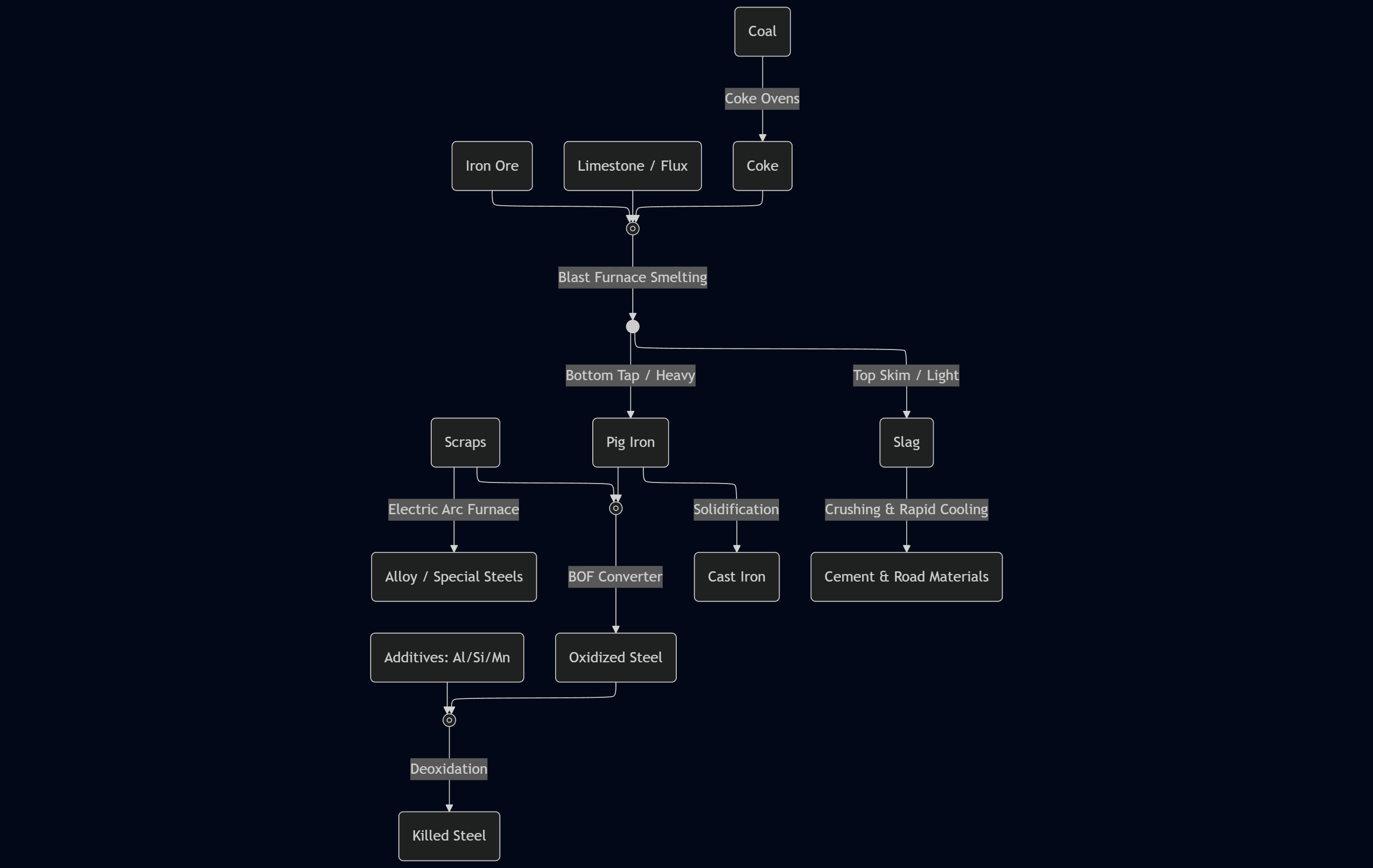
BOF = Basic Oxygen Furnace — a structure that heats up carbon-rich pig iron (4-5%) with the presence of a lot of oxygen, allowing carbon to burn off.
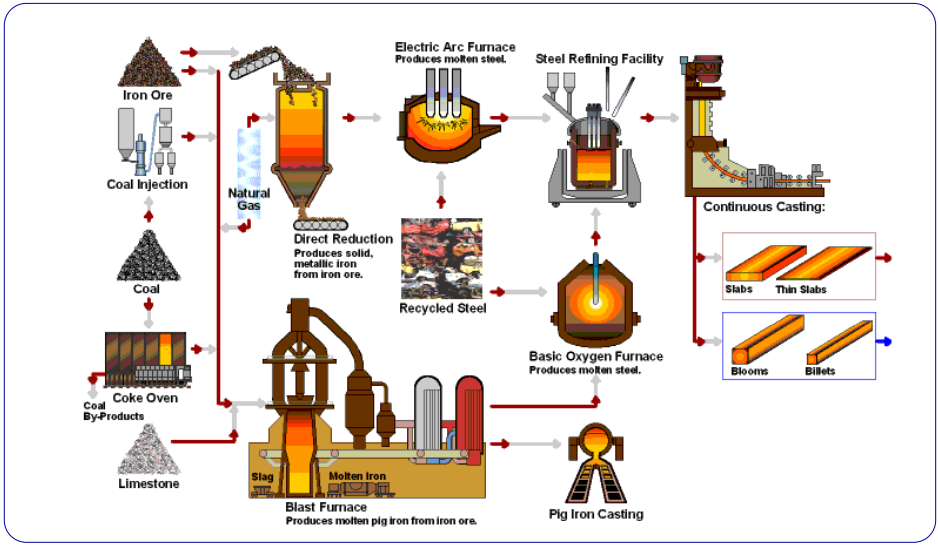
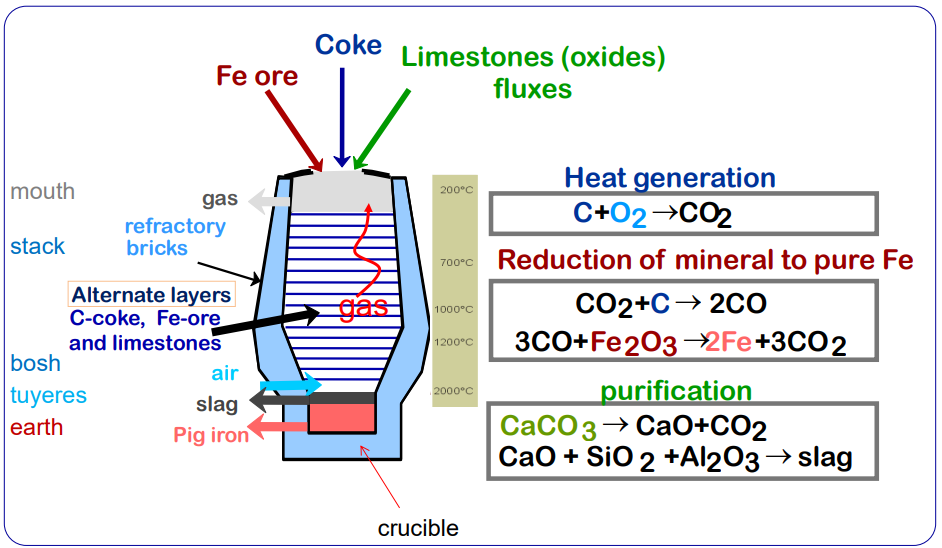
Inside a Blast Furnace
Basic Oxygen Furnace (BOF)
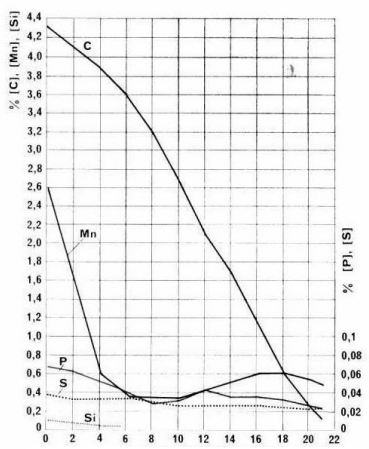
A graph showing how concentration of impurities changes over time (x-axis, in minutes) when inside a BOF. Note that if the steel is “overcooked,” it will oxidize and therefore become useless.
Impurities
Harmful Impurity Limits
For high purity steels, the following are thresholds for “harmful” impurities:
impurities are detrimental for ALL steel grades except for rephosphorize and resolphurized steels, where the impurities are intentionally added.
- contributes to segregation at GBs and therefore causing embrittlement
- causes embrittlement due to segregation
are always present because they contribute to melt purification.
Resolphurized steels are sometimes used to allow for brittle chips to be easily removed during machining. However, sulphur contents remain low ().
Oxygen Removal
After the steel is processed in the DOF, the steel will be filled with excess oxygen within its structure. This MUST be removed since oxidized iron will lead to huge embrittlement, even as low as 100 ppm of oxygen or nitrogen can be detrimental.
There are three ways of fixing this:
- Argon degassing
- Argon is blown into the steel bringing with it. If is left in the steel it will not cause damage since it is inert.
- Vacuum degassing
- The steel is placed in a vacuum chamber, allowing pressure to force the gases out of the steel structure. This can be very expensive.
- Additives
- By adding reactive additives in the structure (such as ), the oxygen will react and can be separated along with slag or stay within the structure as solid precipitates.
- Al is the best for oxygen removal. Silicon is less strong, and manganese is the weakest, but is good for sulphur impurities.
Note
At this point in steel processing, it is all in the form of liquid pig iron.
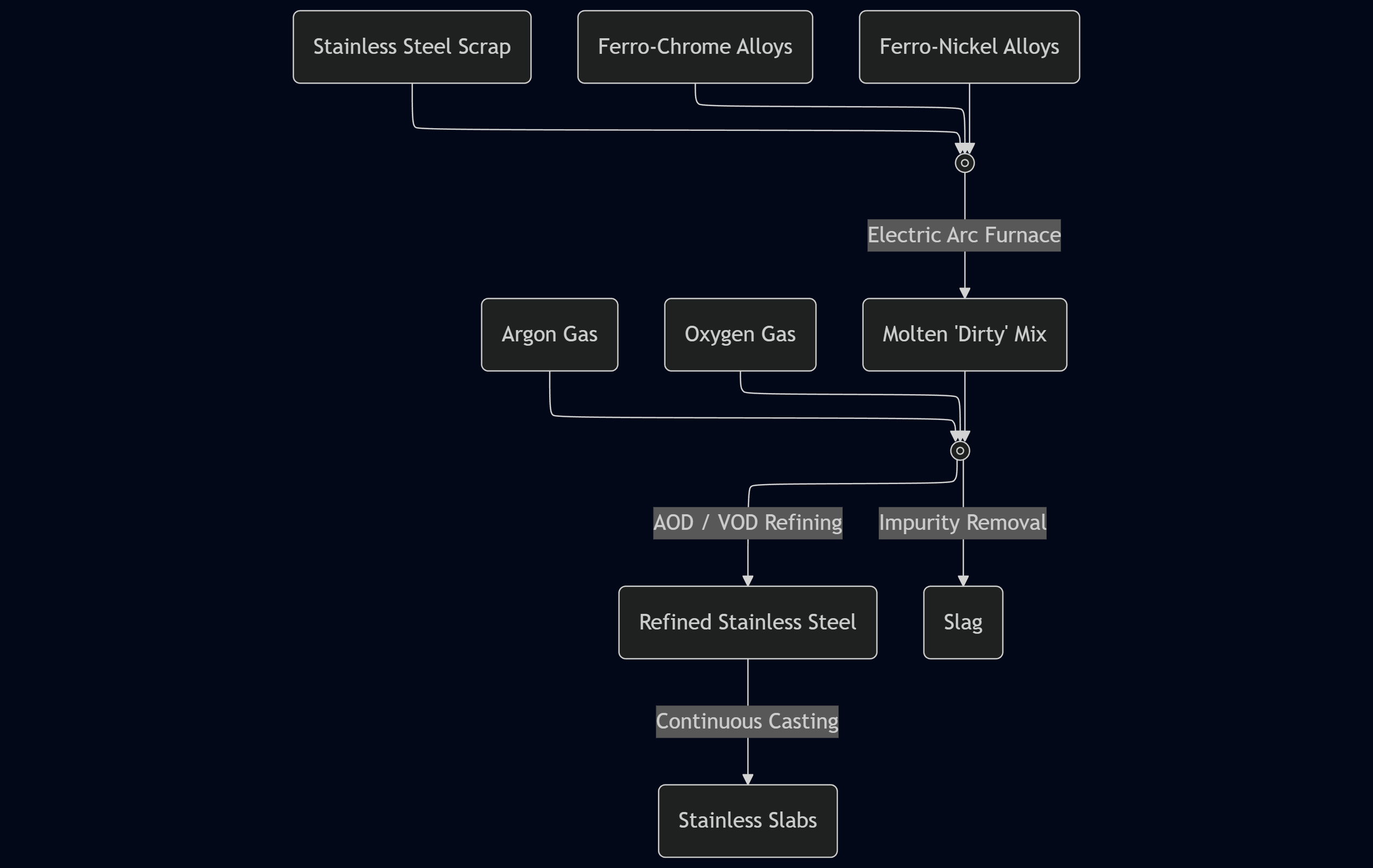
Stainless Steel Production
is very reactive with oxygen, meaning that if we produce stainless steel, we cannot use regular decarbonization methods that use oxygen, or would be the first one to burn off. Since to remove carbon we create a gas (), the reaction will speed up with a lower partial pressure, so the solution is to decrease it (since solid reactions are not affected by pressure).
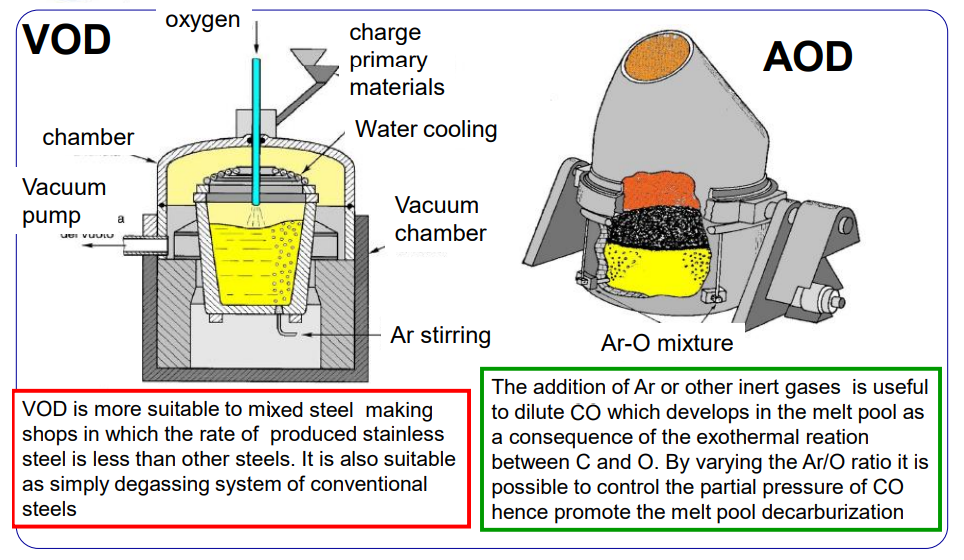
The solution is to use alternative methods:
- VOD (Vacuum Oxygen Decarburization)
- Decarbonization occurs under a vacuum with low oxygen pressure
- This is slow, but can reach very low concentrations of
- AOD (Argon Oxygen Decarburization)
- Rather than creating a vacuum, air is replaced with argon, meaning that PARTIAL pressure decreases, leading to higher reactivity of
- This uses huge amounts of argon
Macrosegregation in Ingots
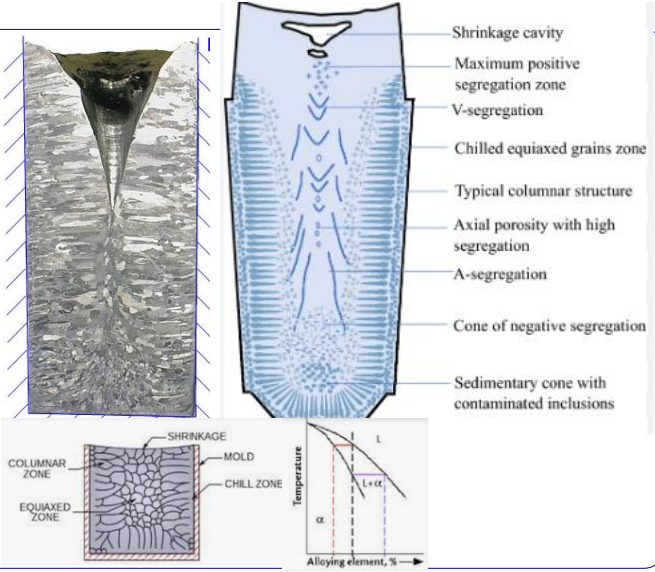
When pouring steel into ingot casts, macro-defects appear in the form of macrosegregation.
Definition
When an ingot is poured into a cast, the outside solidifies earlier, leading to the inner part contracting later. This creates a cone-shaped hole starting from the top of the mould. The result is a loss of about 20% of the steel, which goes back into the processing line (energy, time, and labour are wasted).
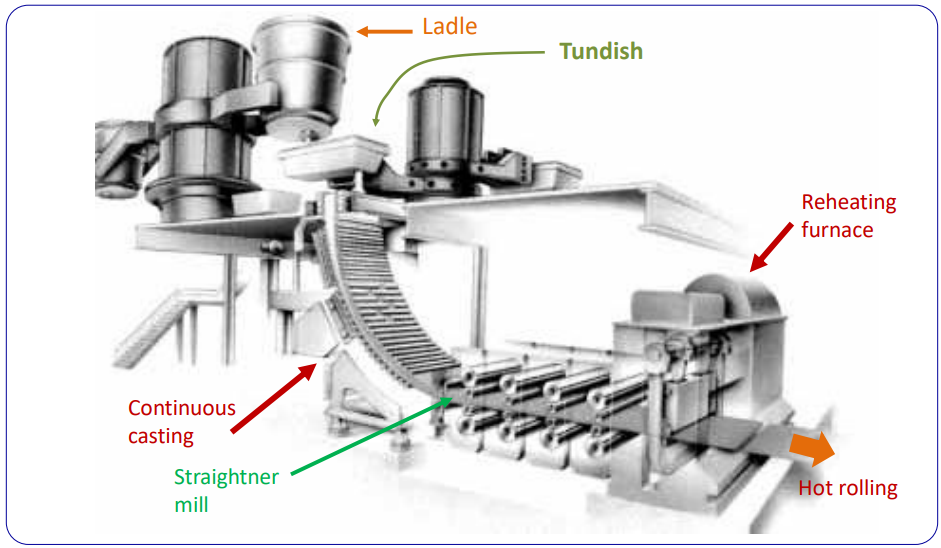
The solution to this is continuous casting:
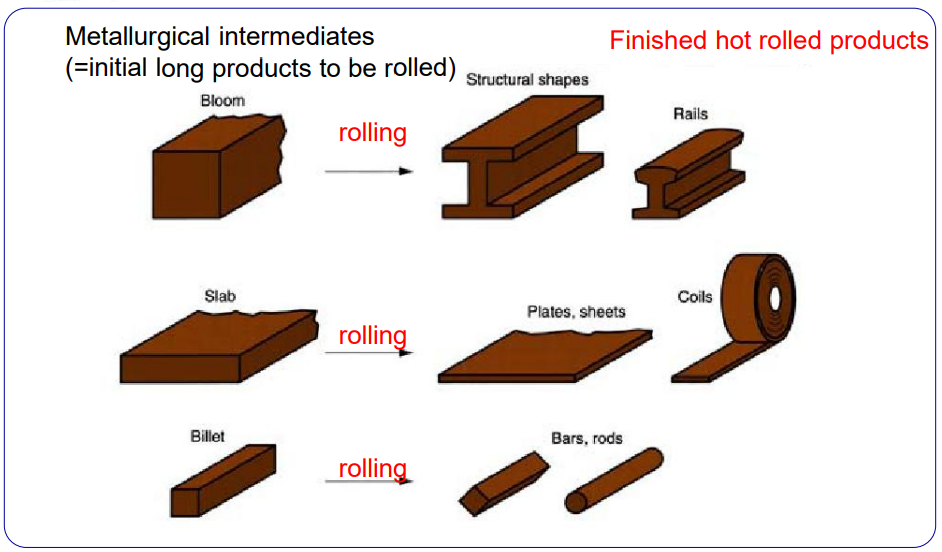
TMCP of HSLA Steels
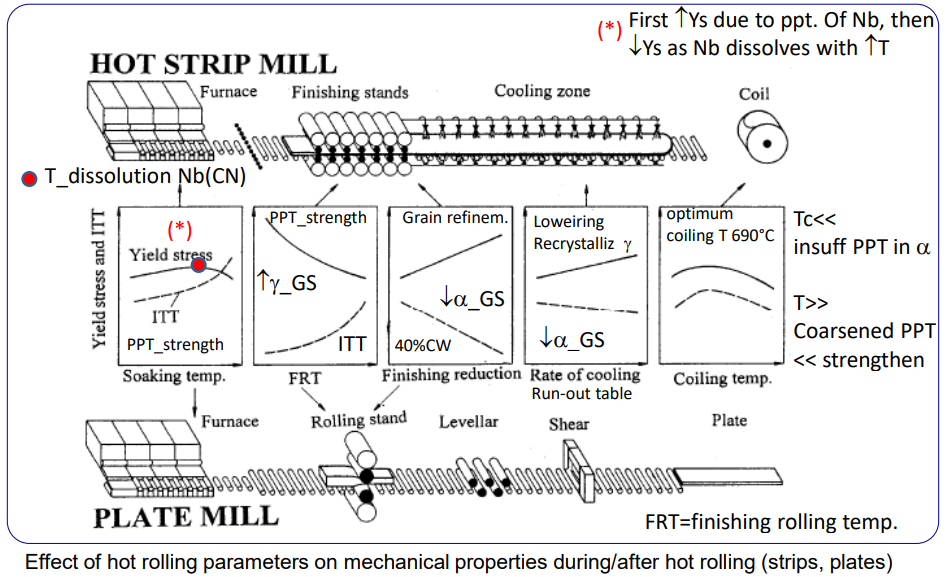
- TMCP (Thermo-Mechanical Control Process): Carefully controlling temperature and deformation of hot rolling to adjust properties of the product.
- HSLA (High-Strength Low-Alloy): A strong form of steel that has few alloying elements in it. It is formed by manipulating physical composition rather than the chemical one.
(in very small amounts, ) is added to strengthen the steel by bonding with to form small, hard precipitates.
The process in the diagram can be summarized as follows:
- Soaking: re-heating of the steel to allow for the niobium carbonitride to dissolve in the steel
- Rolling: Austenite grains get flattened, but cannot re-crystallize since the particles pin the GBs. This produces stressed steel with many defects.
- When cooled down, the stress shatters the brittle ferrite grains into many ultra-fine grains, leading to great strength and toughness.
Inclusions
Definition
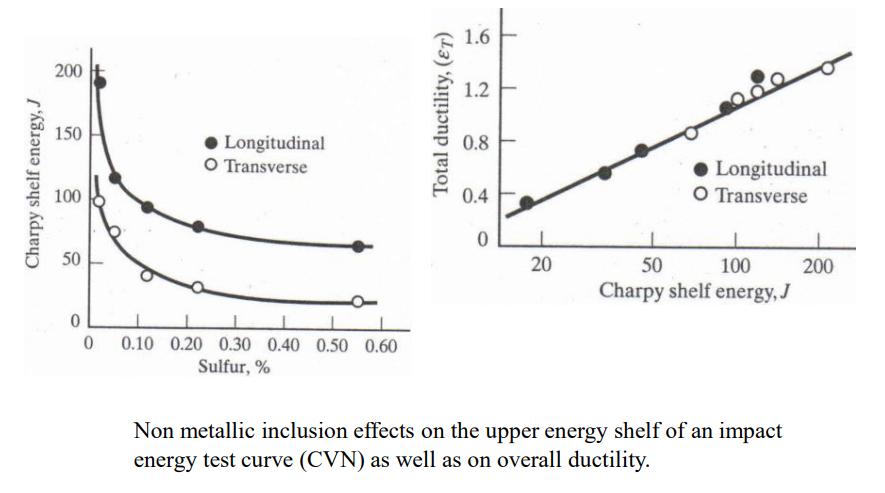
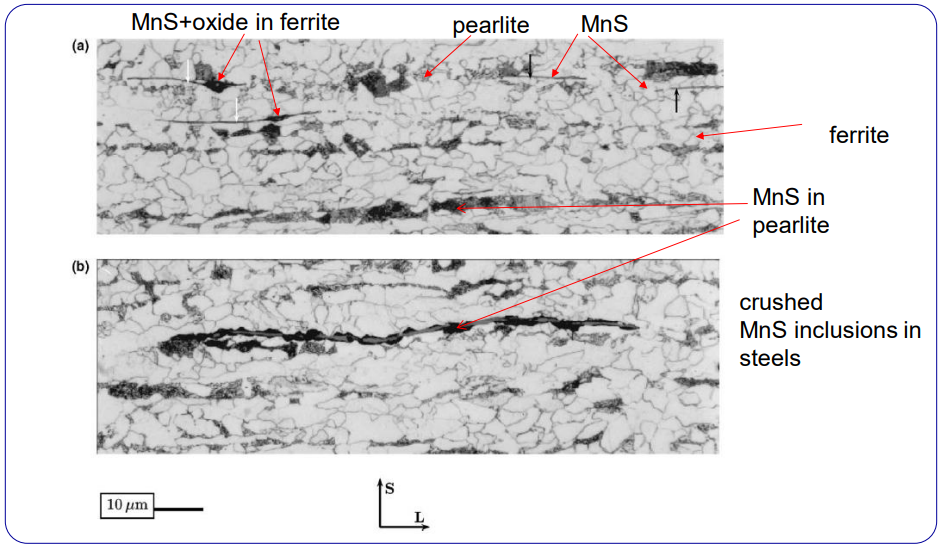
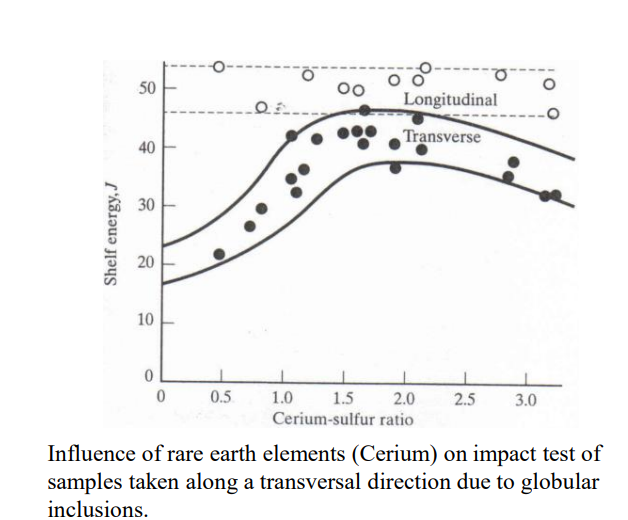
Inclusions are types of Defects that appear during casting of steels. When deoxidizing steel, solids such as are formed. Usually, these float to the surface with slag, but some can remain in the steel and form solid precipitates which cause embrittlement.
Cooling Rates for Different Forms of Steel
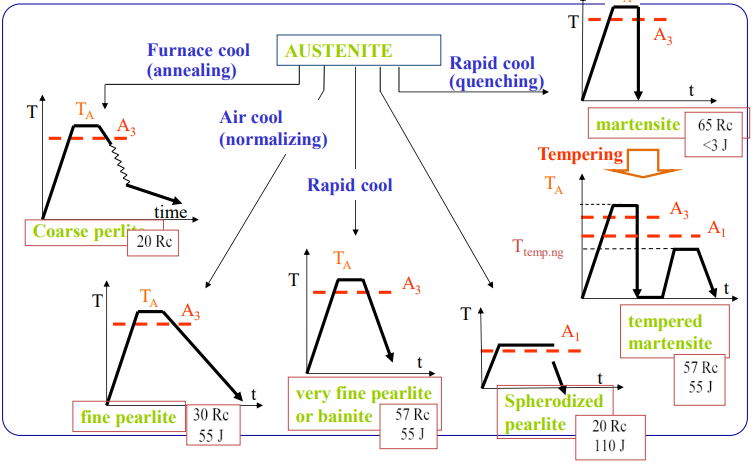
bainite is defined in here.