Combined Yield Strength
- : the “starting point” for the material (Peierls-Nabarro Stress)
- : Solid Solution
- : Grain Boundaries
- : Strain Hardening
An application in the production of 7XXX Al-alloy:
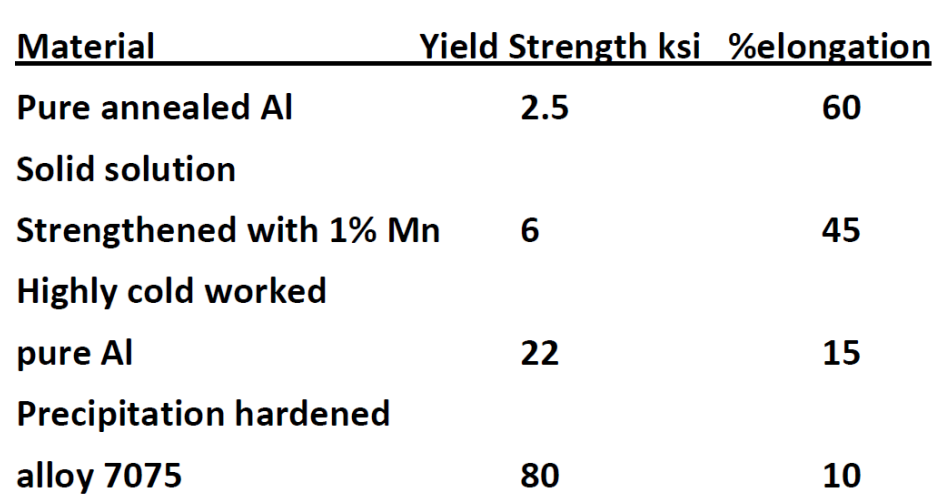
Main strengthening methods of alloys
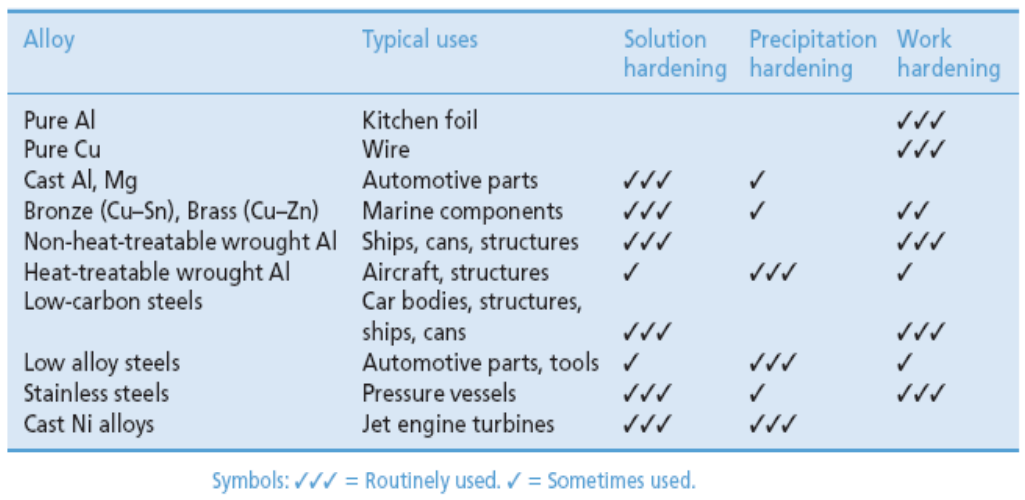
Unique Properties of Metals
- many methods of part shaping (wrought, casting, PM, joining, etc.)
- Many methods of strengthening (as well as a large variety of mechanical properties)
- Excellent compromise between high-strength and high-toughness
- Sensitive to cooling/heating rates
- Can combine structural and functional performance
- Can undergo significant plastic deformation
Inconveniences:
- Affected by environmental and on-service degradation and embrittlement
- Very sensitive to strain rate
- Sensitive to transition temperature
Properties of “The Big 6” Metals
| Property | Iron (Fe) | Aluminium (Al) | Copper (Cu) |
|---|---|---|---|
| Available? | Yes (Very Abundant) | Yes (Most Abundant Metal) | Yes (Moderate) |
| Cheap? (£ / tonne 1997) | Yes (~£100 - £150) | Medium (~£1,000) | No (~£1,500 - £1,800) |
| M.P. (°C) | 1538 | 660 | 1085 |
| Density () | 7870 | 2700 | 8960 |
| Allotropy | Yes (BCC , FCC ) | No (Always FCC) | No (Always FCC) |
| Dissolves things? | Yes (Carbon, Nitrogen) | Yes (Copper, Magnesium, Silicon) | Yes (Zinc, Tin, Nickel) |
| T-Variable solubilty | Yes (Crucial for Steel hardening) | Yes (Crucial for Age hardening) | Yes (Variable) |
| Compounds | Carbides (), Oxides | Alumina (), Intermetallics | Oxides (), Sulfides |
| Stability | Poor (Rusts/Oxidizes rapidly) | Good (Protective Oxide Layer) | Good (Noble / Forms Patina) |
| Hazardous? | No (Essential nutrient) | No (Dust can be explosive) | No (Salts can be toxic) |
| Property | Nickel (Ni) | Titanium (Ti) | Magnesium (Mg) |
|---|---|---|---|
| Available? | Medium (Sulfide ores) | High (Abundant but hard to extract) | High (Sea water / Dolomite) |
| Cheap? (£ / tonne 1997) | No (~£4,000) | Very Expensive (~£8,000+) | Medium (~£1,500) |
| M.P. (°C) | 1455 | 1668 | 650 |
| Density () | 8908 (Heavy) | 4506 (Light-ish) | 1738 (Very Light) |
| Allotropy | No (FCC) | Yes (HCP BCC ) | No (HCP) |
| Dissolves things? | Yes (Cr, Fe, Co - Superalloys) | Yes (Al, V, O) | Yes (Al, Zn, Mn) |
| T-Variable solubility | Yes (Precipitation hardening) | Yes (Phase transformation) | Yes (Age hardening) |
| Compounds | Intermetallics ( ) | Oxides (), Carbides | Oxides (), Hydrides |
| Stability | Excellent (High Temp & Corrosion) | Excellent (Passivates instantly) | Poor (Galvanic corrosion / Flammable) |
| Hazardous? | Yes (Allergen / Carcinogen dust) | No (Biocompatible) | Yes (Dust/Chips are explosive) |
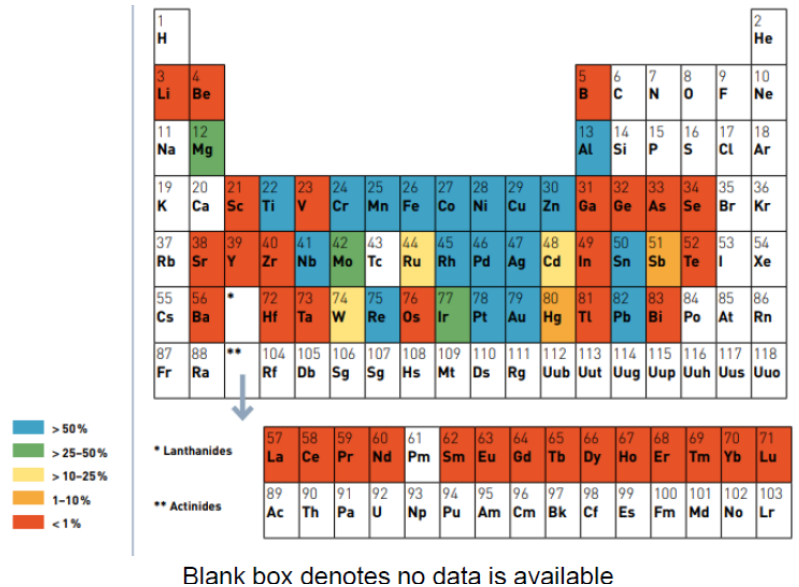
Recycling Rate of Elements
Materials Substitution Table
| Material | Consumption | Value | Import content | Energy | Resource life | Security of supply | Ease of use | Recycle potential |
|---|---|---|---|---|---|---|---|---|
| Steel | 1 | 0 | 4 | 2 | 4 | 4 | 4 | 3 |
| Aluminium | 2 | 3 | 3 | 0 | 3 | 3 | 4 | 4 |
| Copper | 2 | 2 | 3 | 2 | 3 | 2 | 5 | 4 |
| Lead | 3 | 3 | 3 | 3 | 2 | 3 | 5 | 5 |
| Zinc | 3 | 3 | 2 | 1 | 2 | 3 | 4 | 3 |
| Tin | 4 | 4 | 2 | 3 | 1 | 1 | - | 2 |
| Nickel | 4 | 4 | 1 | 3 | 4 | 4 | - | 1 |
| Magnesium | 4 | 4 | 2 | 0 | 5 | 5 | 3 | 3 |
| Mercury | 5 | 5 | 0 | 2 | 1 | 0 | - | 4 |
| Glass | 2 | 2 | 5 | 3 | 5 | 5 | 2 | 3 |
| Brick | 0 | 2 | 5 | 5 | 5 | 5 | 2 | 0 |
| Concrete | 0 | 1 | 4 | 4 | 5 | 5 | 3 | 0 |
| Timber | 1 | 1 | 2 | 5 | 4 | 3 | 4 | 2 |
| Plastic | 2 | 1 | 2 | 1 | 3 | 4 | 4 | 1 |
Info
The above table shows ratings for several categories for certain materials. The ratings are in the range of 0 (meaning very bad) to 5 (meaning excellent).
Properties Involved In Selection of Materials
- Chemical composition
- Contamination of contents by corrosion products
- Corrosion characteristics in:
- Atmosphere
- Water
- Soil
- Chemicals
- Gases
- Molten metals
- Creep characteristics @ temperature range
- Crystal structure
- Damping Coefficient
- Density
- Effect of cold working
- Effect of high temperature on corrosion resistance
- Effect on strength after exposure to hydrogen and high temperatures
- Electrical conductivity
- Electrical resistivity
- Fire resistance
- Hardenability
- Maximum temperature not affecting strength
- Melting point
- Corrosion factor
- Susceptibility to corrosion:
- General
- Hydrogen damage
- Pitting
- Galvanic
- Corrosion fatigue
- Fretting
- Stress corrosion cracking
- Corrosion/erosion
- Cavitation damage
- Intergranular
- Selective attack
- High temperature
- Thermal coefficient of expansion
- Thermal conductivity
- Wearing quality:
- Inherent
- Via heat treatment
- Via plating