Magnetic field is therefore generated by a charge accelerating in an electric field. It is perpendicular to both.
Important
Force due to magnetic fields is much smaller than force due to electric fields unless approaching relativistic speeds
Lorentz Force
Notation:
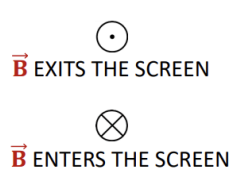
Note
Lorentz Force is conservative, meaning that no work is performed.
Circular Motion
In an isolated environment with a uniform field and a moving charge, at all times, therefore leading to circular motion.
Lorentz Force on a Wire
Hall Effect
If a wire is in a magnetic field, charges are affected by the Lorentz Force, therefore creating a higher density of charge on one side than the other, leading to a potential difference.
Magnetic Dipole
Similar to an Electric Dipoles, two equal charges with opposite sign which are connected to each other have a magnetic dipole moment or sometimes .
We can define the magnetizing field as:
To apply it to the magnetization vector, defined as the total magnetic dipole moment per unit volume. For small fields:
Where depends on the characteristics of dipoles, is the dipole density and is the magnetic susceptibility of the material.
We can use this to get the TOTAL magnetic field in a material:
Which for small fields can be approximated to:
With being the magnetic permeability of the material.
Biot-Savart Laws
First Law (Laplace’s Law)
Second Law
Where
Application to a circular loop
In a closed loop, we can calculate the magnetic field along its axis:
The loop behaves similarly to a bar magnet, and it therefore has a Magnetic Dipole moment:
Direction is given by right hand rule, following the current around the loop.
Ampere Law
Application to a wire
If we apply Ampere’s Law to a circular path of radius centred around an infinitely long wire with current , we get
And we can use this on two parallel wires of lengths :
If currents are in equal direction, the force is attractive, otherwise it is repulsive.
Ampere-Maxwell Law
When the field is time-dependant, we cannot use the standard form, we therefore correct it to:
Where is called the displacement current (it does not have anything to do with displacement though).
Gauss Law for Magnetic Fields
For a closed surface: