Types of Properties
- Intrinsic Properties: related to atom bonding (The material itself)
- Density
- Thermal conductivity
- Elasticity
- Thermal Expansion Coefficient
- Extrinsic Properties: Affected by either the addition of impurities or by microstructure as a consequence of materials processing (What we do to the material)
- Yield strength
- Hardness
- Elongation
- Impact energy (resilience)
- Toughness and fracture toughness
- Fatigue resistance
- Creep resistance
- Corrosion and oxidation resistance
Electrical resistivity is VERY sensitive to impurities/nanoscopic defects.
Types of Interstitial Sites
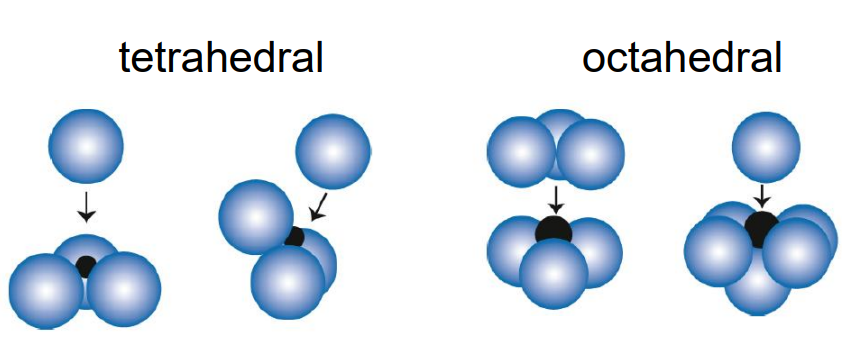
There are two types:
- Tetrahedral
- There are twice as many interstitial sites as there are atoms in the lattice structure
- Octahedral
- There are as many interstitial sites as there are atoms in the lattice structure, but those spots are larger than the ones in the tetrahedral structure
Note
Despite the name “octahedral”, the primitive structure has 6 atoms, not 8. (It has 8 faces)
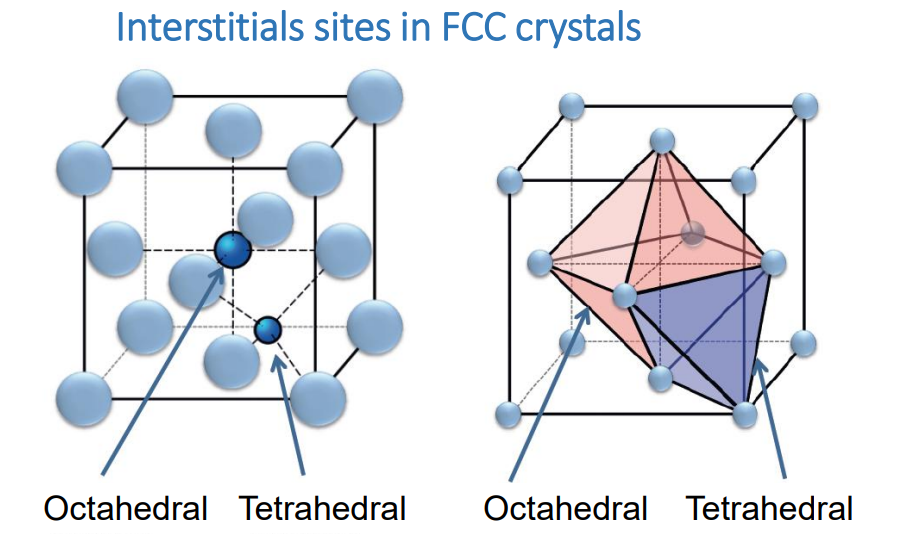
This has applications in metallurgy, such as sin the production of steel. (ferrite) is tightly packed with more interstitial sites, but the slots are smaller, meaning that very little carbon can fit (). However, above , the iron structure changes into the FCC (austenite), which has fewer larger sites. This actually allows for way more carbon to fit in (up to ). By then quenching the material, we can get the structure to readjust to its room temperature BCC formation, while retaining the carbon within it.
Crystal Anisotropy
Because atomic packing is not the same in all directions (atoms are more tightly packed on specific crystallographic planes), mechanical properties differ depending on the direction of the load. In a single crystal, this is anisotropy.
In polycrystalline materials, because of the large number of randomly oriented grains, these anisotropic properties usually average out, making the material macroscopically isotropic. However, mechanical processing (like rolling) can force grains to align in a preferred orientation. This creates texture (or banding), re-introducing macroscopic anisotropy where properties differ relative to the rolling direction.
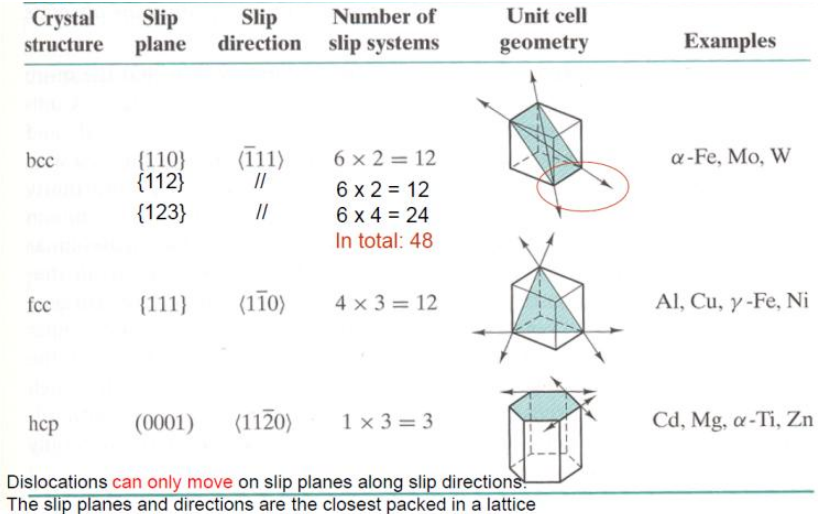
Plastic deformation occurs on Slip Systems. A single Slip System is defined as the combination of a specific Slip Plane and a Slip Direction.
Each structure (FCC, BCC, HCP) has characteristic slip systems. The ductility of the material depends on the number of independent slip systems available. According to the (Taylor) Von Mises Criterion, a polycrystal requires at least 5 independent slip systems to deform arbitrarily without cracking. FCC metals (12 systems) satisfy this and are ductile; HCP metals (often <5 systems) do not, and are often brittle unless they deform by twinning.