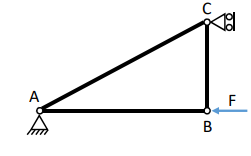
External forces are only applied to the internal hinges (nodes).
In each rod, the only internal action is the normal load
- If , then the beam is loaded by traction
- If , then the beam is loaded by compression
Simplified degree of static determinacy
Solution Strategy
- Compute (Check if isostatic).
- External Reactions: Treat the whole truss as a single rigid body first. Ignore the insides. Solve for the ground supports ().
- Internal Forces ():
- Method of Nodes: Solves every rod (good for full analysis).
- Method of Sections (Ritter): Solves specific rods (good for finding just one or two forces).
Method 1: Equilibrium at Nodes
The Logic
Isolate a specific node (hinge) and treat it as a particle. Since the node is in equilibrium, the sum of forces acting on it must be zero.
Procedure:
- Isolate a Node: Start with a node where you have at least 1 known force and no more than 2 unknown rods (since you only have 2 equations: ).
- Draw Vectors:
- Draw known external forces.
- Draw unknown rod forces () pointing AWAY from the node.
- Note: We always assume Traction (+) initially.
- Solve:
- Interpret signs:
- Result : Assumption correct (Traction).
- Result : Rod is in Compression.
- Repeat: Move to the next connected node and use the values you just found.
Spotting "Zero Force" Members
Sometimes you can spot rods with just by looking.
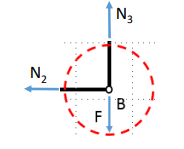
- Example: Look at Node B. A vertical force balances the vertical rod (). However, nothing opposes the horizontal rod (). Therefore, to maintain equilibrium, must be zero.
Method 2: Method of Sections (Ritter)
The Logic
Instead of solving node-by-node, you “cut” the truss into two separate rigid bodies. The internal forces of the cut rods become external forces on the new sections.
The Rules of the Cut:
- Cut Max 3 Rods: You only have 3 equilibrium equations (), so you cannot solve for more than 3 unknowns.
- No Common Node: The three cut rods cannot all meet at the same node (otherwise the moment equation becomes useless).
The “Ritter” Strategy: To find the force in a specific rod (e.g., Rod A) without doing extra maths:
- Identify the other two rods you cut (Rods B and C).
- Find their intersection point (Point P).
- Sum Moments about Point P ().
- Since Rods B and C pass through P, their moment is zero.
- You are left with an equation containing only Rod A.