The Phenomenon:
The formulas derived from Saint-Venant (e.g., ) assume the cross-section changes gradually or is constant. In reality, machine parts have abrupt changes like holes, grooves, or shoulders (called Notches or Stress Raisers). These features cause the stress lines to “crowd” together, creating a local peak stress () significantly higher than the average.
The Theoretical Stress Concentration Factor ()
We quantify this effect using a simple multiplier, the Geometric Stress Concentration Factor ().
- : The actual peak stress at the root of the notch (principal stress).
- : The “Nominal Stress” calculated using standard formulas (, ) on the Net (Minimum) Cross-Section.
Warning: The Net Area
When calculating , you must always use the dimensions of the reduced section (diameter ), not the gross section (diameter ).
Methods of Calculation
Since standard beam theory fails at the notch, how do we find ? There are three main approaches:
A. Analytical Methods (Historical)
- Kirsch (1898): Solved the stress state around a circular hole in an infinite plate.
- Neuber (1930): Contributed significant solutions for various geometries.
- Limitation: Exact analytical solutions only exist for very simple shapes.
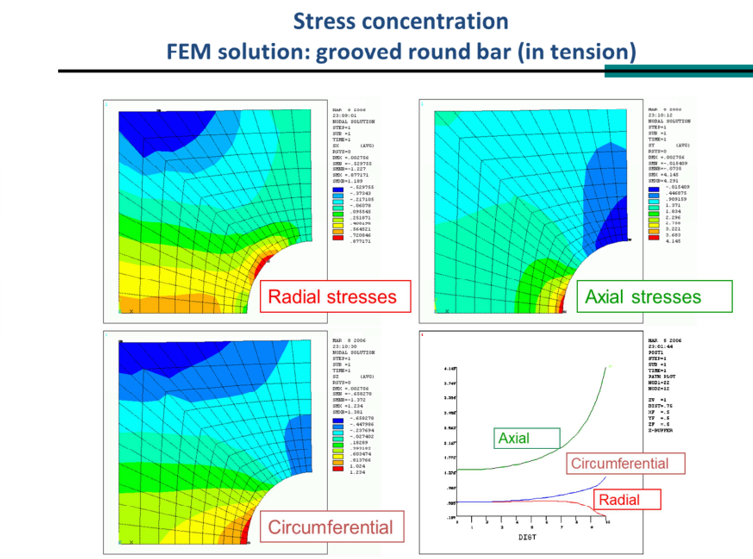
B. Numerical Methods (Modern Standard) Using computer simulations to solve the elasticity equations approximately.
- FEM (Finite Element Method): Discretizes the part into a mesh.
- BEM (Boundary Element Method): Discretizes only the surface.
- Visual Evidence: The FEM solution for a grooved bar shows how axial stress peaks at the root of the notch while radial stress develops inside.
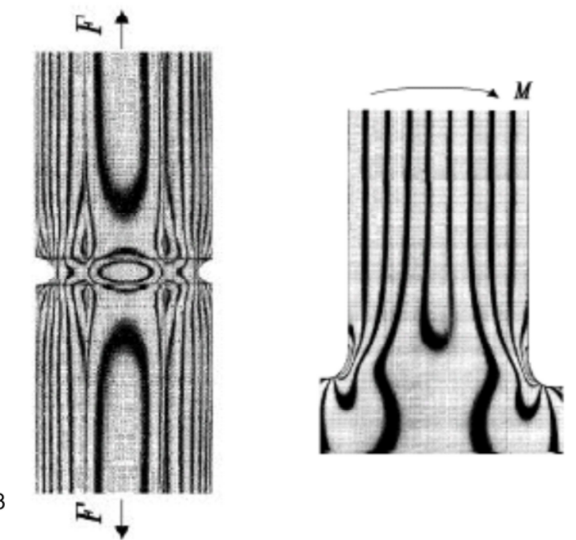
C. Experimental Methods Used to validate theories or test complex parts.
- Photoelasticity: Uses optical properties of stressed plastic models to visualize stress fringes.
- Strain Gauges: Measures strain at specific points.
- Brittle Coatings: Cracks form in the coating perpendicular to max tensile stress.
3. Dependencies
The value of depends only on:
- Geometry: The sharpness of the notch (radius ) and the size of the transition ().
- Loading Mode: A specific notch behaves differently under Tension, Bending, or Torsion.
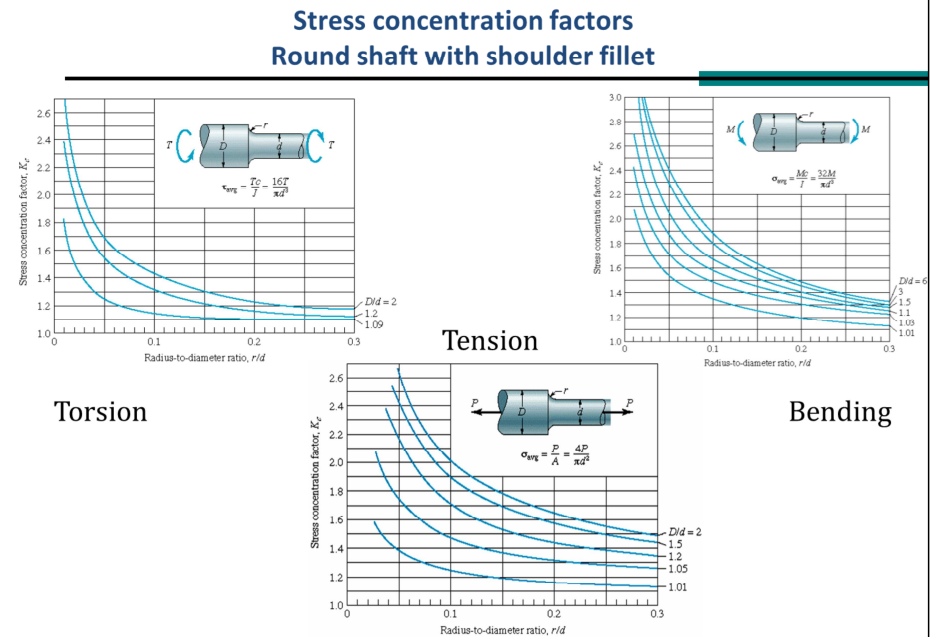
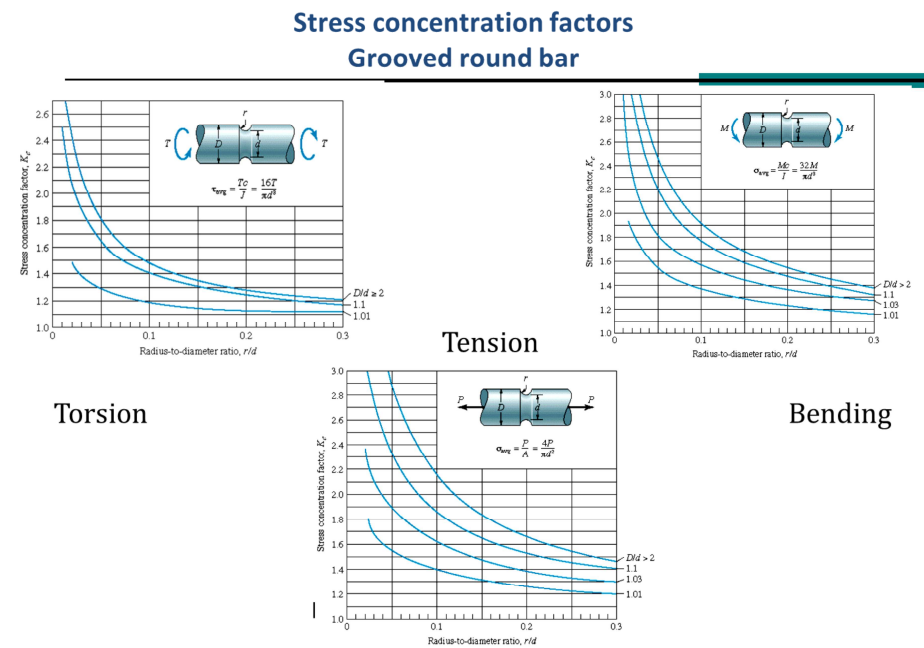
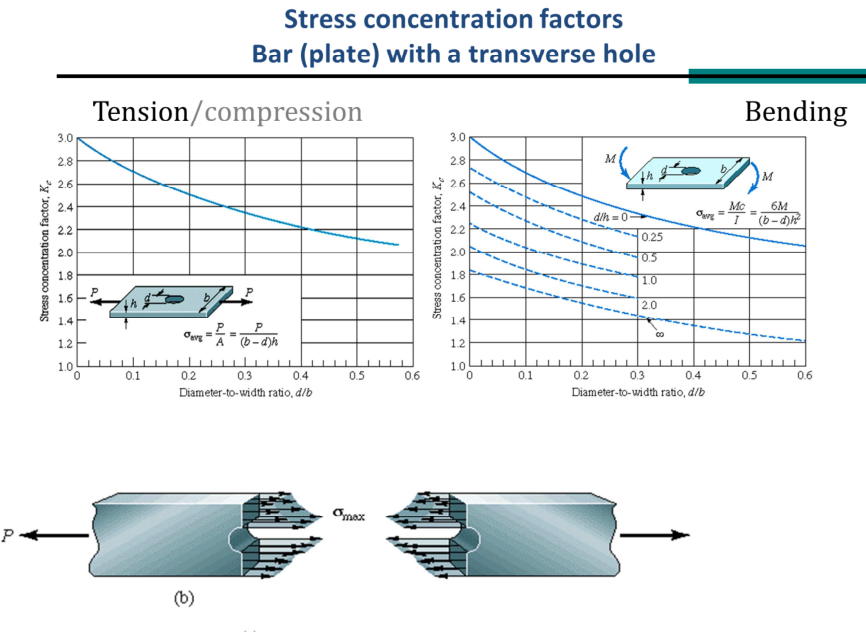
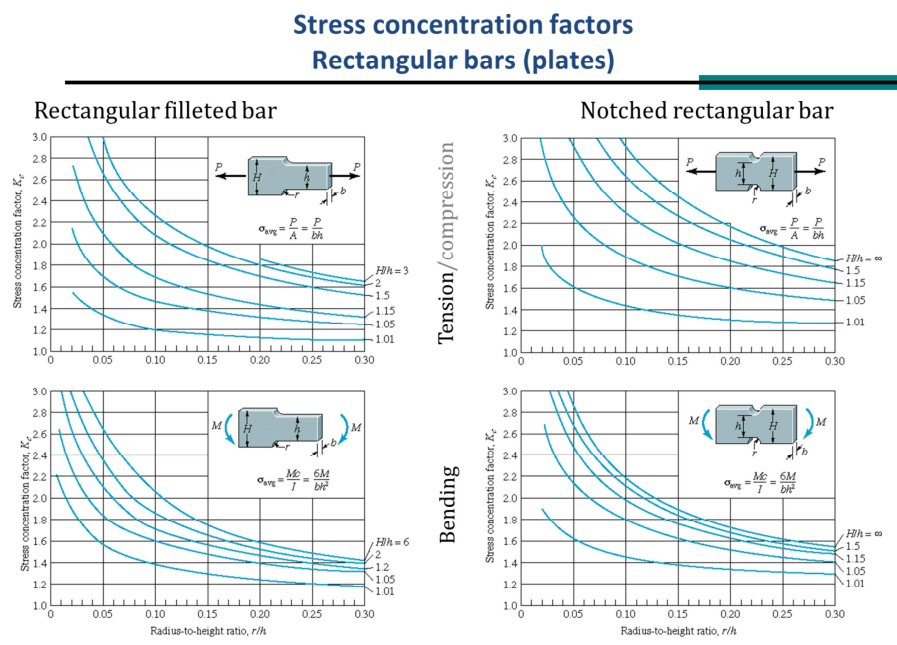
4. Peterson’s Charts (Design Tool)
Engineers use published charts (from R.E. Peterson) to find quickly without running a simulation.
Procedure:
- Calculate geometric ratios: (x-axis) and (curve selection).
- Read from the y-axis.
- Calculate peak stress: .