TIP
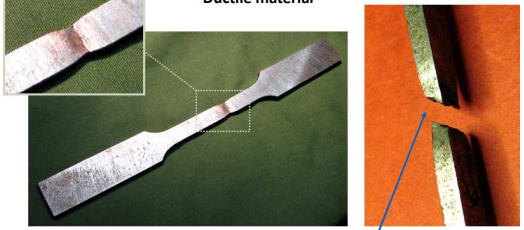
Ductile materials fracture after necking (yielding), while brittle materials will suddenly snap with an uneven pattern (snapping). Brittle:
Ductile:
Von Mises Criterion
Not to be confused with the Taylor-Von Mises Criterion from STM/TMM!
SUMMARY
The von Mises criterion states that a ductile material yields when the distortion (deviatoric) energy density at a point reaches the critical value observed at the yield limit in a simple uniaxial tensile test.
Ductile materials (like steel) do not care if you squeeze them evenly from all sides (pressure). They only care if you try to twist or warp them (distortion).
The Energy Split
We can separate the total energy inside the material into two buckets:
- Bucket A (Safe): Energy that changes volume. This is caused by “Hydrostatic Stress” (pressure). It does not cause yielding.
- Bucket B (Dangerous): Energy that changes shape (distortion/warping). This is caused by “Deviatoric Stress”. This is what breaks the material.
The Result: “Equivalent Stress”
The derivation boils all that complex 3D stress down to a single number called the von Mises Equivalent Stress ( or ).
- Why? So you can compare a complex real-world mess (3D stress) to a simple 1D Tensile Test.
- The Rule: If your calculated “Distortion Number” () is higher than the Yield Strength () from the simple test, the part fails.
The Only Formula You Actually Need
Forget the derivation. This is the weapon you wield:
If , it yields.
Comparison: Tresca vs. Von Mises
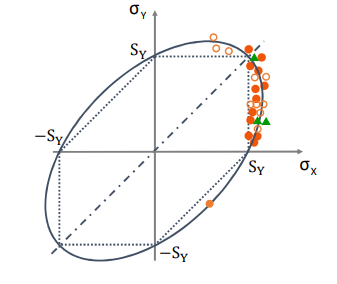
Visualizing the Yield Surface
- Tresca (Hexagon): The inner shape. Conservative (predicts failure earlier). It “cuts the corners”.
- Von Mises (Ellipse): The outer shape. It allows higher stress states in the corners (shear + tension).
- Reality: Experimental data (orange dots) clings to the Von Mises Ellipse, making it the accurate choice for ductile metals.
Summary Checklist
| Material | Criterion | Formula () | Limit |
|---|---|---|---|
| Ductile | Tresca | ||
| Ductile | Von Mises | ||
| Brittle | Rankine | (Max Principal) |
Safety Factor ()
The Law: Real components are almost never designed to the limit. We apply a margin for uncertainty (loads, material defects).
- Brittle Materials: High Safety Factor (). Failure is sudden and catastrophic.
- Ductile Materials: Lower Safety Factor (). Material yields (warns you) before snapping.
Allowable Stress ()
Sometimes standards give you the max allowed stress directly instead of an :
- where .