Assumptions
- Electrons cannot leave from the surface.
- Electrons can move freely within the material
When a conductor is in an electric field, the conductor creates an opposing field to nullify the effect of the field and reach static equilibrium.
To do this, charged particles move to a surface (electrons move against the field). This is called induction, and the charge forced to the surface is called induced charge.
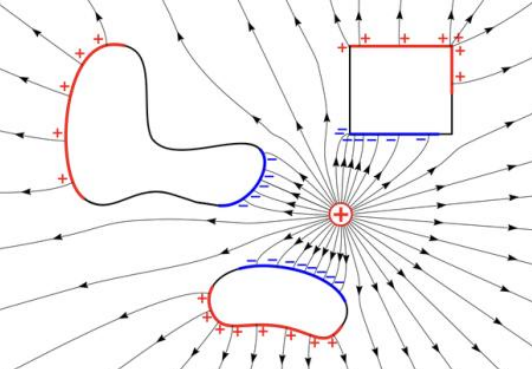
Charged Conductors
If a conductor is forced to be charged, electrons are forced to surfaces, creating zero field everywhere in the material. They tend to clump up on sharp edges and needle-shaped surfaces.
Columb's Law
For a charged conductor with surface charge density of , the electric field close to the surface (outside) is:
Electric field will be greater at the tips, since there is a higher charge density.
Hollow Conductors and Shielding
- Internal Field: In stable equilibrium, the electric field inside a hollow conductor’s cavity is zero (assuming no charges are inside).
- Internal Charges: If a charge is placed inside, the inner surface accumulates (cancelling the field), and the outer surface gains .
- Shielding: External fields cannot penetrate the conductor, creating a protected space (e.g., Faraday cages like cars).
- Potential: Because the internal field is zero, there is no potential difference anywhere in the conductor (); it is an equipotential volume.