Strain is deformation caused by an applied stress.
Types of Strain
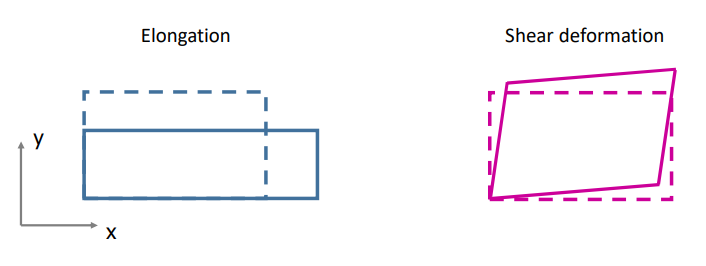
- Elongation Strain (): It measures how much a material stretches or squashes in a specific direction (change in length per unit length).
- Shear Strain (): It measures how much the angle between two originally perpendicular lines changes (distortion of the corner of a square).
The Strain Tensor
Just like stress, strain is a tensor field. It varies point-by-point.
Trap: Engineering vs. Tensor Shear
The tensor components () are NOT the same as the “Engineering Shear Strain” () used in calculations.
- Tensor Shear:
- Engineering Shear:
Why? The tensor must be symmetric. The factor of splits the total angle change () equally between the two faces.
Volumetric Strain ()
The sum of the diagonal terms (the Trace) tells you how much the Volume changes (Dilation).
- : Expansion (Dilation).
- : Contraction (Compaction).
- : Incompressible material (Volume is constant, only shape changes).
Principal Strains
Exactly like Stress, there is a specific orientation where Shear Strain is zero.
- These are the Principal Strains ().
- You can find them using Mohr’s Circle for strain (identical process to stress, just plot on x-axis and on y-axis).
The Displacement Gradient ()
The derivative of displacement () tells us how a point moves relative to its neighbours. It contains two things mixed together: Deformation and Rigid Rotation.
We mathematically split it to isolate the strain:
1. The Strain Tensor ()
- Maths: The Symmetric part of .
- Physics: Represents pure stretching and shape change. Causes Stress.
2. The Spin Tensor ()
- Maths: The Skew-Symmetric part of .
- Physics: Represents rigid body rotation. Causes NO Stress.
Constitutive Equations (Hooke’s Law)
Linear Elasticity (1D)
For a simple bar pulled in one direction (Uniaxial):
Hooke’s Law
- : Young’s Modulus (Stiffness). Higher = Stiffer material.
We can use Hooke’s law to get force and work done in two occasions:
1. Instantaneous (Constant Force) Force is at 100% from start to finish.
- Note: Contains 2x the energy of the progressive case.
2. Progressive (Linear Force) Force grows from 0 to max as displacement increases.
- Note: Area of the triangle under the curve ().
Poisson’s Ratio () When you pull a rubber band, it gets thinner. Poisson’s ratio measures this necking effect.
- Range: (Most metals ).
Energy Density
Generalized Hooke’s Law (3D)
In the real world, stress in one direction () causes strain in all directions (due to Poisson). For an Isotropic material (same properties in all directions), the equations are:
Normal Strains
Shear Strains Shear is decoupled from normal stress. It depends on the Shear Modulus ().
Shear Modulus
In matrix form:
- For Isotropic materials (standard metal), this giant matrix is mostly zeros. You only need two numbers to fill it: and .
- The matrix is Symmetric (), so you “only” need 21 constants for the worst-case scenario (like wood or composites), not 36.
Thermal Strain
Temperature changes cause expansion/contraction without stress (unless constrained).
- : Coefficient of thermal expansion.
- Total Strain: The sum of mechanical stress + thermal expansion.
Some Properties
| Metal | ||
|---|---|---|
| Steel | ||
| Cast Iron | to | |
(max allowed stress) for steel, which corresponds to .
| Material (minimum values) | Type/Grade | (MPa) | (MPa) | A% |
|---|---|---|---|---|
| STEEL - Structural | S 235 | 235 | 360 | 26 |
| (UNI EN 10025) | S 275 | 275 | 430 | 22 |
| S 355 | 355 | 510 | 22 | |
| STEEL - annealed | C 30 | 400 | 600 | 18 |
| (UNI EN 10083) | C 60 | 580 | 850 | 11 |
| 41Cr4 | 800 | 1000 | 11 | |
| 36NiCrMo3 | 1050 | 1250 | 9 | |
| CAST IRON | G10 | - | 100 | - |
| Gray | G20 | - | 200 | - |
| G30 | - | 290 | - | |
| CAST IRON | Gs370-17 | 230 | 370 | 17 |
| Spheroidal | Gs500-7 | 320 | 500 | 7 |
| Gs700-2 | 420 | 700 | 2 |
NOTE
Values represent minimum thresholds. For Gray Cast Iron, yield strength () and elongation () are typically not defined due to the material’s brittle nature.